

Scientists Discover How Correlated Disorder Boosts Superconductivity

Superconductivity is a unique state of matter in which electric current flows without any energy loss. In materials with defects, it typically emerges at very low temperatures and develops in several stages. An international team of scientists, including physicists from HSE MIEM, has demonstrated that when defects within a material are arranged in a specific pattern rather than randomly, superconductivity can occur at a higher temperature and extend throughout the entire material. This discovery could help develop superconductors that operate without the need for extreme cooling. The study has been published in Physical Review B.
Superconductivity is a state in which electric current flows through a material without any energy loss. In conventional conductors, part of the energy is converted into heat, but in superconductors, this does not occur—current flows freely and does not weaken. Today, superconductors are used in applications such as MRI machines, where superconducting coils generate strong magnetic fields. In the future, superconductors may also be integrated into systems that require lossless power transmission and high-speed signal processing. The challenge is that nearly all superconductors function only at temperatures below -140 °C, which limits their practical use. To make them more viable, physicists are working to raise their operating temperature and improve stability.
Researchers from the HSE MIEM Centre for Quantum Metamaterials, in collaboration with colleagues from MEPhI, MIPT, and the Federal University of Pernambuco, Brazil, have shown that superconductivity can be made more stable by controlling the placement of defects. Defects are deviations from a material’s ideal crystal lattice, such as excess or missing atoms, impurities, and distortions. They usually disrupt the movement of electrons and weaken superconductivity, but it is impossible to eliminate them entirely, especially in multicomponent materials. Rather than eliminating these imperfections, the scientists have proposed arranging them in a specific pattern. This type of defect distribution is known as correlated disorder.

Alexei Vagov
'Imagine a crowd of people moving chaotically in different directions—that’s a classic example of disorder. Now imagine the same crowd moving in a complex but coordinated pattern, like a mass dance—that illustrates correlated disorder,' says Alexei Vagov, Professor at the HSE Tikhonov Moscow Institute of Electronics and Mathematics. 'In superconductors, it turns out that this kind of order within disorder causes defects to actually enhance superconductivity.'
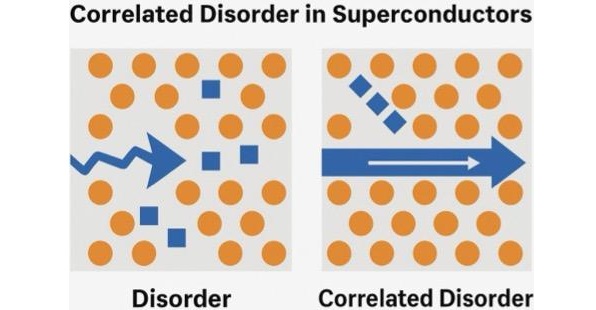
In materials with defects, superconductivity typically develops in two stages. First, isolated regions appear where superconductivity begins to emerge. Then, as the temperature drops, these regions connect, allowing current to flow throughout the entire sample. Scientists have modelled a two-dimensional superconductor with varying defect distributions—from random to correlated, where impurities are interconnected. The results show that when disorder in the material is coordinated rather than chaotic, the transition happens immediately: superconductivity emerges simultaneously throughout the entire system.
The scientists believe these findings could aid in the development of thin superconducting films, whose structures closely resemble the model used in the study. When synthesising such films, it is possible to control the placement of defects in advance, which is useful both for testing the theory and for creating materials with specified properties.
'Controlling the placement of defects at the microscopic level could enable the creation of superconductors that operate at much higher temperatures—potentially even at room temperature. This would transform superconductivity from a laboratory rarity into a technology used in everyday devices,' comments Alexei Vagov.
The study was conducted with support from the Ministry of Education and Science, Grant 075-15-2025-010, and HSE University's Basic Research Programme within the framework of the Centres of Excellence project.

See also:

Scientists Train Neural Network to Generate Process Plans from 3D Models
Researchers at the HSE FCS AI and Digital Science Institute have developed CAD2TechSpec, a framework that converts 3D models of mechanical parts into machining process plans—step-by-step instructions for machine tools. The solution aims to reduce the time required for the design and preparation of technical process documentation in mechanical engineering, aircraft manufacturing, and other high-tech industries. The study findings have been published in PeerJ Computer Science.
Biologists Discover 'Molecular Fingerprint' of Preeclampsia
Researchers at HSE University employed a new method to model hypoxia in placental cells during pregnancies complicated by preeclampsia and identified molecular markers of tissue hypoxia. Since hypoxia is one of the key mechanisms underlying preeclampsia, these findings are important for a more accurate and timely diagnosis of the disease and for the development of effective treatment methods. The paper has been published in Placenta.
‘Hedgehog’ Versus ‘Relatives’: Researchers Measure How the Brain Responds to Unexpected Words During Natural Speech
Russian neurophysiologists, including researchers from HSE University, have demonstrated the feasibility of using event-related fields (ERFs) to study brain activity during natural speech perception. The researchers showed that this approach can be applied not only to individual words but also to continuous speech. Their findings indicate that words whose meanings differ significantly from the preceding context require longer processing times. The study also reveals that the brain processes function words in two stages: first, it identifies their grammatical role and then uses this information to predict the next word. The study has been published in Frontiers in Human Neuroscience.
HSE Researchers Create New Corpus of Early Child Speech in Russian
Researchers at the HSE Centre for Language and Brain have presented RusLan-M, an open multimedia corpus that makes it possible to trace the development of early child speech in Russian from first words to the emergence of complex grammatical constructions. The database contains around 41 hours of video recordings and more than 35,000 child utterances. The new resource will help researchers study more precisely how children acquire Russian and, in the longer term, develop more reliable tools for assessing speech development. The study has been published in Language Resources and Evaluation.
Hybrid Intelligence: Competencies in the Age of AI Discussed at Technoprom-2026
Artificial intelligence is not creating new professions, but rather transforming the nature of existing ones. This was the conclusion reached by participants in the panel session ‘Hybrid Intelligence: Digital and Human Drivers of Development,’ organised by the Institute for Statistical Studies and Economics of Knowledge (ISSEK) at HSE University as part of the 13th International Forum of Technological Development (Technoprom-2026). The experts discussed how the nature of work is changing, which skills are becoming increasingly sought after, and what prevents companies from fully capitalising on new technologies.
Scientists Develop New Solution for 6G Communication Systems
A terahertz neuromorphic circuit developed by scientists at HSE University could make 6G communication systems both more accurate and energy-efficient. The circuit enables indoor tracking of mobile devices with an accuracy of up to 99%. The results were presented at PIERS 2026, an international symposium on Photonics and Electromagnetism held in China.
Scientists Develop Algorithm for More Reliable Processors in Data Centres
Researchers from HSE MIEM and Samara University have developed the LRF-3D algorithm to automatically bypass idle nodes in three-dimensional networks-on-chip. Thanks to its hierarchical architecture, the algorithm outperforms existing solutions in both speed and path accuracy, improving processor reliability for use in data centres, supercomputers, and AI computing. The source code and test results are publicly available.
Researchers Rank Recommendation Algorithms Using Sports Tournament Model
Researchers from the AI and Digital Science Institute at the HSE Faculty of Computer Science have developed an approach for selecting recommendation algorithms more effectively. Their approach uses pairwise comparisons of algorithms to create a tournament table, with the overall ranking based on their performance across all datasets in the tournament. This can reduce the number of algorithms that need to be tested when developing new services, saving both time and money. The study was presented at the 32nd ACM SIGKDD Conference on Knowledge Discovery and Data Mining (KDD 2026).
Researchers Develop Method for Direct Generation of Regulatory DNA
Researchers at HSE University have developed a model for generating promoters and enhancers—DNA sequences that regulate gene activity. The model works directly with DNA nucleotides, without first transforming them into a continuous numerical representation. This solution could be useful for applications in synthetic biology and gene therapy. The study results were presented at the ICLR 2026 Workshop ‘Generative AI in Genomics (Gen^2): Barriers and Frontiers.’
Researchers at HSE University and Sber Train Neural Networks to Better Predict User Preferences
The HSE FCS AI and Digital Science Institute and Sber have introduced a new architecture for recommendation systems that combines two classes of models, enabling algorithms to better predict users’ interests and needs. A preprint of the paper has been published on arxiv.org and presented at Urban ML.