

HSE University and University of Campinas Join Forces to Build Alternative Financial System
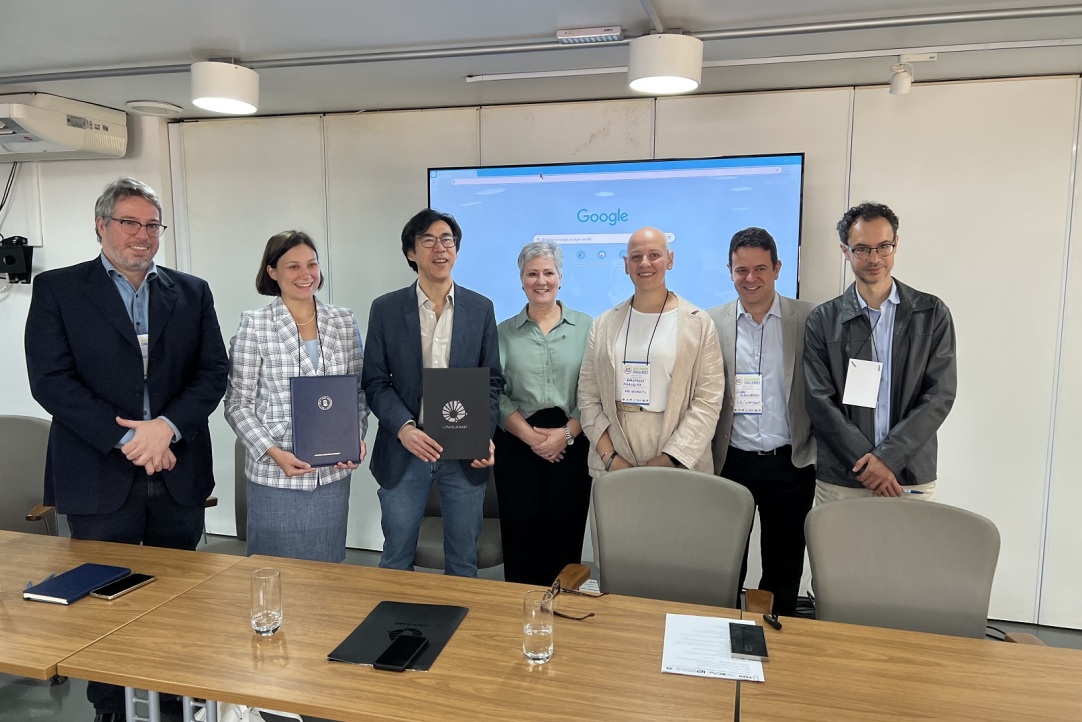
HSE University and the University of Campinas (UNICAMP, Brazil) have announced the launch of a major joint research project to develop new approaches to an alternative international financial system. The initiative, which brings together leading experts in global economics and finance, seeks to analyse the current state of international financial architecture and explore ways of transforming it in the context of a changing geopolitical landscape.
The project was officially launched during the first joint winter school of HSE University, UNICAMP, and Durban University of Technology (DUT), held in Campinas on August 25–26, 2025. The start of the project was announced by Alexandra Morozkina, Deputy Dean for Research at the HSE Faculty of World Economy and International Affairs (WEIA), and Célio Hiratuka, Director of the Institute of Economics at UNICAMP.
According to Alexandra Morozkina, the overlap in the universities’ research interests in the field of economic blocs has helped to build long-term friendly relations. The researchers plan to focus on the study of international financial flows in BRICS countries and the possibilities for expanding settlements in national currencies.

The project envisages active involvement of both universities’ students and postgraduates. The partnership will entail joint research projects, academic articles, conferences, and seminars.
Students from HSE University’s Faculty of World Economy and International Affairs and the University of Campinas presented projects for future joint publications at the postgraduate forum of the BRICS conference. For example, Alina Semenova, a Master’s student in the World Economy programme, and Alisson Oliveira de Souza Carvalho, a postgraduate student at the Institute of Economics, announced their forthcoming paper ‘National Payment Systems Under Pressure: Lessons from Russia and Brazil for the Development of BRICS Pay’—a strategic analysis of building sovereign payment infrastructure in a multipolar world. The analysis is based on an exchange of Russian and Brazilian experience in establishing national payment systems.

Timofey Petrov, a third-year student on HSE University’s International Relations and Global Studies programme, and Vanessa Nakedi, a student at the University of Campinas Institute of Economics, presented a draft paper entitled ‘Normative Power of BRICS: Reconceptualising Development in a Shifting Geopolitical Order.’ The article examines the role of BRICS in reshaping the global narrative of international economic assistance. It assesses the bloc’s effectiveness as a counterbalance to entrenched aid practices that prioritise donors’ geostrategic interests at the expense of recipients’ sovereignty and sustainable development.

Kirill Lysenko, a PhD student on HSE University’s Economics programme, and João Guilherme Marques Augusto Monteiro, a PhD student at UNICAMP, proposed an analysis of the ‘middle-income trap.’ In their work, the doctoral students plan to examine a broad range of issues underlying slow progress in national development—from inefficient income redistribution systems to resource dependence and low investment in research and development.

Fyodor Alekseev, Junior Research Fellow at HSE University’s Laboratory for Economics of Climate Change, together with Flávio Vinius Ferreira, a student at the University of Campinas Institute of Economics, presented a draft paper entitled ‘Green Industrial Policies and Regional Climate Cooperation: Insights from Brazil and Beyond.’ The article aims to explore the extent to which green industrial policies in Brazil, Chile, and Mexico create the foundations for regional climate cooperation in Latin America.
The HSE University WEIA delegation took an active part in the school’s programme, which included lectures and discussions. Alexandra Morozkina and Anastasia Podrugina, Associate Professor at HSE’s School of World Economy, delivered a lecture entitled ‘Feel the Fear and Do It Anyway: Approaches to an Alternative Financial System,’ presenting an analysis of the dominance of the dollar in the global financial system and the prospects for expanding settlements in national currencies, including within BRICS. Professor Igor Makarov, Head of HSE’s School of World Economy, gave a talk ‘Towards a New Sustainable Development Agenda Beyond 2030,’ in which he highlighted the need to transform the current model of economic development and underlined the key role of BRICS countries in shaping new approaches.
Participation in the winter school at the University of Campinas marked an important step for HSE in strengthening international partnerships, expanding academic exchange, and preparing a new generation of researchers ready to address complex challenges in international finance and sustainable development.

See also:

Biologists Discover 'Molecular Fingerprint' of Preeclampsia
Researchers at HSE University employed a new method to model hypoxia in placental cells during pregnancies complicated by preeclampsia and identified molecular markers of tissue hypoxia. Since hypoxia is one of the key mechanisms underlying preeclampsia, these findings are important for a more accurate and timely diagnosis of the disease and for the development of effective treatment methods. The paper has been published in Placenta.
‘Hedgehog’ Versus ‘Relatives’: Researchers Measure How the Brain Responds to Unexpected Words During Natural Speech
Russian neurophysiologists, including researchers from HSE University, have demonstrated the feasibility of using event-related fields (ERFs) to study brain activity during natural speech perception. The researchers showed that this approach can be applied not only to individual words but also to continuous speech. Their findings indicate that words whose meanings differ significantly from the preceding context require longer processing times. The study also reveals that the brain processes function words in two stages: first, it identifies their grammatical role and then uses this information to predict the next word. The study has been published in Frontiers in Human Neuroscience.
Scientists Develop Algorithm for More Reliable Processors in Data Centres
Researchers from HSE MIEM and Samara University have developed the LRF-3D algorithm to automatically bypass idle nodes in three-dimensional networks-on-chip. Thanks to its hierarchical architecture, the algorithm outperforms existing solutions in both speed and path accuracy, improving processor reliability for use in data centres, supercomputers, and AI computing. The source code and test results are publicly available.
Researchers Develop Method for Direct Generation of Regulatory DNA
Researchers at HSE University have developed a model for generating promoters and enhancers—DNA sequences that regulate gene activity. The model works directly with DNA nucleotides, without first transforming them into a continuous numerical representation. This solution could be useful for applications in synthetic biology and gene therapy. The study results were presented at the ICLR 2026 Workshop ‘Generative AI in Genomics (Gen^2): Barriers and Frontiers.’
Researchers at HSE University and Sber Train Neural Networks to Better Predict User Preferences
The HSE FCS AI and Digital Science Institute and Sber have introduced a new architecture for recommendation systems that combines two classes of models, enabling algorithms to better predict users’ interests and needs. A preprint of the paper has been published on arxiv.org and presented at Urban ML.
HSE Graduate School of Business and Alfa-Bank Hold Summer School for Students from China
Twenty-seven students from Chinese universities took part in the international summer school ‘Digital Product Management’ organised by the HSE Graduate School of Business and Alfa-Bank. Over the course of a week, participants explored the Russian economy and business environment, learned about current technology trends, and worked through the key stages of digital product development step by step—from researching user needs and defining a problem to developing a prototype and presenting their final project.
Physicists Discover What Happens Inside a Stable Vortex
Large vortices with characteristic spiral arms are often observed in the atmosphere and the ocean. Physicists from HSE University have explained how these structures form and why they retain their shape. The researchers found that velocities at points located along the same vortex arc remain correlated even over long distances. At the same time, this correlation weakens rapidly with increasing distance from the vortex centre. These differences help explain the formation of spiral arms and may improve models of atmospheric and oceanic currents. The findings have been published in Physical Review Fluids.
‘The Peak of Stupidity’ and ‘The Valley of Despair’: HSE Economists Propose an Explanation for the Dunning–Kruger Effect
The Dunning–Kruger effect, which describes a sharp surge in self-confidence among beginners followed by an equally rapid decline as they gain experience, can be explained by the nature of the learning process and the acquisition of new knowledge. This conclusion was reached by Andrey Vorchik of the HSE Faculty of Economic Sciences together with independent researcher Murat Mamyshev. They developed a mathematical model of learning and demonstrated how subjective confidence is formed and changes as knowledge accumulates, as well as how teachers can reduce the ‘valley of despair’ experienced by learners.
Toffee and Risk: Scientists Discover Why People Who Crave Sweets Make More Impulsive Choices
Having a sweet tooth may be linked not only to eating habits but also to the way people make decisions. Researchers at HSE University have found that people with a preference for sweet foods tend to behave more impulsively—not because they want immediate rewards, but because they are less willing to tolerate uncertainty. These findings may help improve treatments for addiction. The study findings have been published in Frontiers in Psychology.
‘Beyond Developing a Powerful Skill Set, ICEF Also Helped Build My Resilience’
Umarkhon Isaev, from Tashkent, Uzbekistan, graduated from the International Bachelor's Programme in Economics and Finance at ICEF HSE in 2026. In this interview, Umarkhon talks about what made ICEF the ideal place to pursue his interest in finance, how his programme challenged him in ways he had never experienced before, and why it’s important to find friends who have your back when times are tough.