

HSE and Vietnam National University to Establish Joint Research Institute
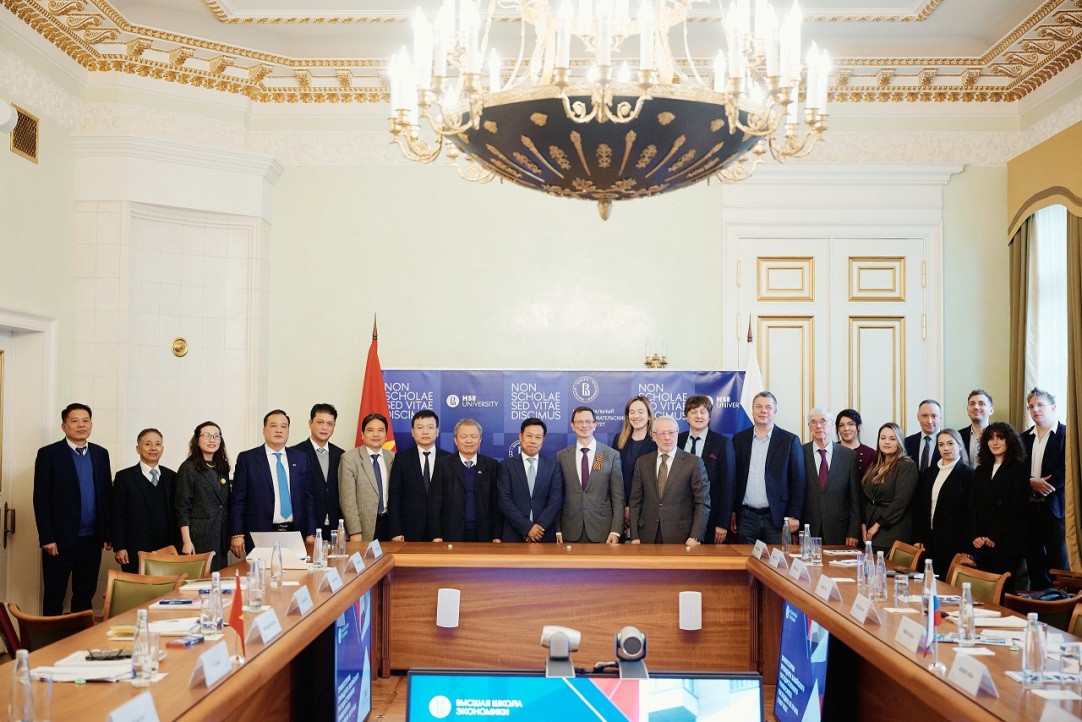
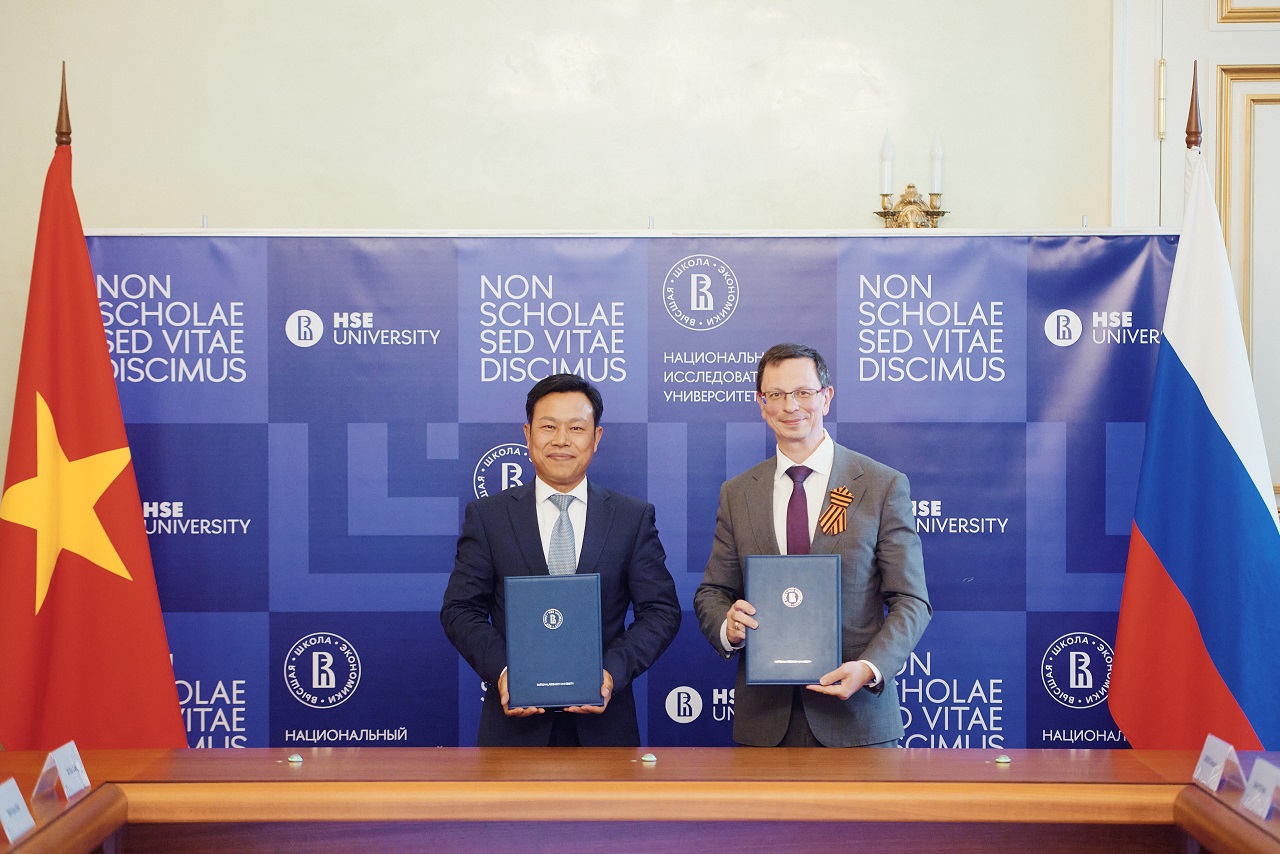
A cooperation agreement has been signed in Moscow between HSE University and Vietnam National University, Hanoi (VNU). The document was signed during the official visit of a Vietnamese delegation to celebrations marking the 80th anniversary of Victory Day and negotiations involving President of the Russian Federation Vladimir Putin and General Secretary of the Central Committee of the Communist Party of Vietnam Tô Lâm. The agreement was signed by HSE Rector Nikita Anisimov and VNU Rector Le Quan.
The joint research institute will focus on cutting-edge developments, the coordination of bilateral research programmes, academic exchanges, and the enhancement of scientific capacity.
On May 12, a meeting took place at HSE University between the delegation from Vietnam National University, led by Rector Le Quan, and HSE Rector Nikita Anisimov, along with other university representatives. The parties discussed key aspects of launching joint projects and the concrete steps required for their implementation.
During the Vietnamese delegation’s visit, HSE University also signed an agreement with the Vietnam Academy of Science and Technology (VAST). HSE University and VAST agreed to strengthen scientific and cultural cooperation, joint projects, conferences, and the exchange of scientific knowledge.
These initiatives mark a new phase in the scientific and educational partnership between Russia and Vietnam. The expansion of cooperation and the establishment of a shared research space not only strengthen bilateral ties but also enhance both countries’ contributions to the global scientific community, including the development of an intellectual foundation for the sustainable advancement of BRICS.
HSE University has been developing partnerships with Vietnamese educational and research institutions since 2016. It has cooperation agreements in place, including memoranda of understanding, as well as educational, research and academic mobility agreements, with various Vietnamese partners. These include the University of Engineering and Technology at Vietnam National University, the University of Economics in Ho Chi Minh City (UEH), the National Economics University, and others. Between 2020 and 2023, HSE University, in cooperation with the Vietnam Academy of Social Sciences and with the support of the Russian Foundation for Basic Research (RFBR), conducted the research project ‘Cross-Border Interaction, Socio-Cultural Transformations, and Local Communities in the Sino–Vietnamese Border Region in Government Projects of the PRC and Vietnam.’

See also:

HSE Faculty of Social Sciences Develops Partnerships with Chinese Universities
In summer 2026, the HSE Faculty of Social Sciences (FSS) took several steps towards establishing closer ties with leading Chinese universities. The Faculty signed a landmark memorandum with one of China’s top technical universities and also began talks with Peking University. In addition, the International Laboratory for Digital Transformation in Public Administration, affiliated with FSS, held an international summer school in Moscow with the participation of Chinese colleagues.
Algebra, Geometry, and AI: Russian and Vietnamese Mathematicians Discuss Current Research
A delegation of scientists from Hanoi visited the HSE Faculty of Computer Science and then took part in a Russian-Vietnamese conference in St Petersburg. The events were part of the three-year project ‘Flexibility and Computational Methods.’ Over the course of the project, the researchers have prepared joint publications and obtained new mathematical results.
HSE Researchers Present Study on Neural Network Robustness in Video Analysis at ChinaMM 2026
Researchers from HSE University presented a study at the international ChinaMM 2026 conference on how video transmission distortions affect the performance of neural networks. The authors proposed a new approach to testing the robustness of such models under conditions that closely resemble the real-world use of video services.
HSE University to Develop Predictive Analytics System for Icebreaker Motors
Industrial automation is one of the key applications of artificial intelligence. A predictive analytics system for large electric motors is among the solutions being developed for the industry as part of HSE University’s Strategic Technological Project ‘Multi-Agent Platform of AI Solutions for Industry-Specific Tasks.’ What is predictive analytics, how can it improve the operation of electric motors, and what specialists joined forces to develop this technology? Anton Zarubin, Dean of the School of Computer Science, Physics, and Technology at HSE University–St Petersburg and the project development coordinator, explains in this interview with the HSE News Service.
Scientific Expedition to Hainan: HSE Scientists Organise Conference on Statistical AI in China
The Statistical AI Conference was held in Sanya, Hainan Island, China, from 24 to 28 August 2026. The international event brought together leading experts in statistics, machine learning, and applied AI. Alexey Naumov, Director of the AI and Digital Science Institute at the HSE Faculty of Computer Science, and Sergey Samsonov, Head of the International Laboratory of Stochastic Algorithms and High-Dimensional Inference, were among the conference organisers.
5th Fall into ML Conference to Bring Together Leading AI Researchers
The AI and Digital Science Institute at the HSE Faculty of Computer Science invites researchers, developers and everyone shaping the future of technology to the fifth, anniversary edition of the Fall into Machine Learning conference (Fall into ML 2026). The event will take place on October 23–24, 2026, at the HSE Cultural Centre in Moscow and will become the key meeting point for Russia’s AI community.
HSE University to Present Its Projects at the International Youth Festival
The International Youth Festival (IYF) will be held in Yekaterinburg from 11 to 17 September 2026. HSE University will take an active part in the event. The university's booth will present a space settlement mock-up, robots, and the iFORA big data analysis system. Fifty HSE students will visit festival venues, and experts will participate in the business programme.
HSE University Expands Cooperation with Malaysia in Technology Foresight
HSE University researchers will take part in a study of the future of engineering education in Malaysia, while the Malaysian Industry-Government Group for High Technology (MIGHT) will use the iFORA big-data analysis system to validate the findings of its foresight research. These are the outcomes of a visit by HSE representatives to Kuala Lumpur.
Scientists Train Neural Network to Generate Process Plans from 3D Models
Researchers at the HSE FCS AI and Digital Science Institute have developed CAD2TechSpec, a framework that converts 3D models of mechanical parts into machining process plans—step-by-step instructions for machine tools. The solution aims to reduce the time required for the design and preparation of technical process documentation in mechanical engineering, aircraft manufacturing, and other high-tech industries. The study findings have been published in PeerJ Computer Science.
Biologists Discover 'Molecular Fingerprint' of Preeclampsia
Researchers at HSE University employed a new method to model hypoxia in placental cells during pregnancies complicated by preeclampsia and identified molecular markers of tissue hypoxia. Since hypoxia is one of the key mechanisms underlying preeclampsia, these findings are important for a more accurate and timely diagnosis of the disease and for the development of effective treatment methods. The paper has been published in Placenta.